
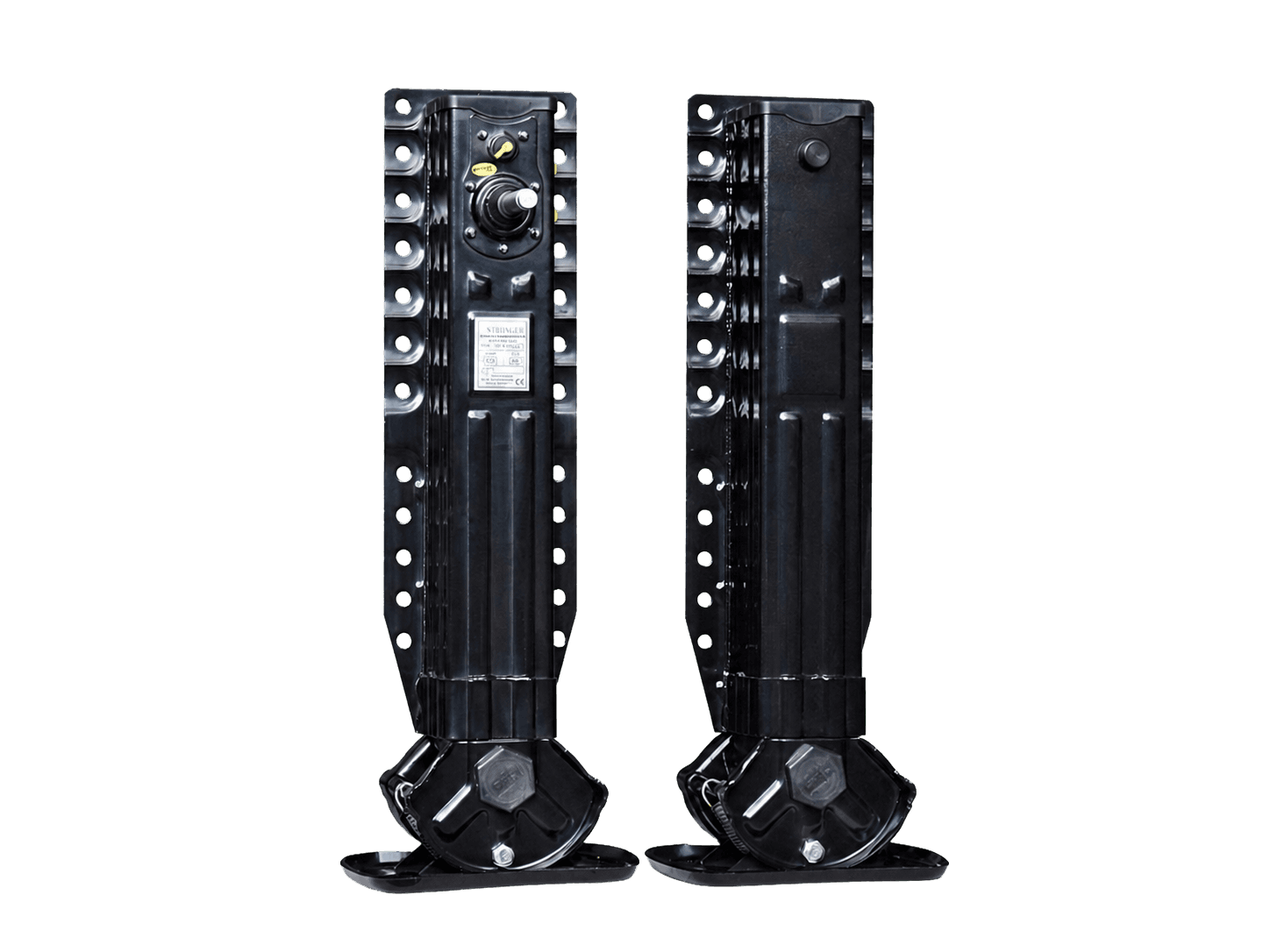
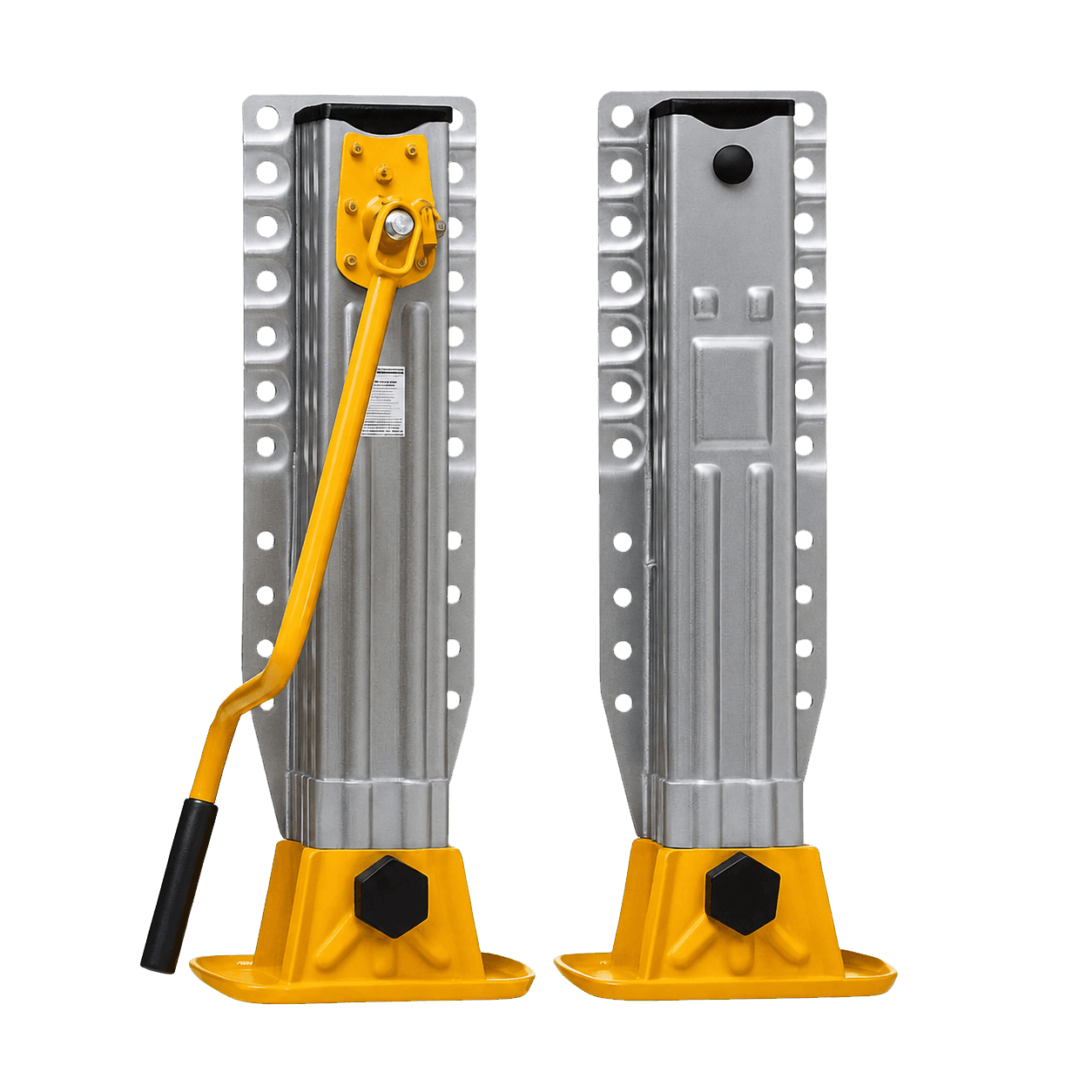
What the component does
A trailer support jack is used when a parked trailer must remain supported without relying only on its running gear or tractor connection. The T-MAX 850S is designed for this type of trailer support application, with a spring-base arrangement and a control layout intended to be accessible to the operator. The spring feature is part of the base configuration; it should not be interpreted as a stated load rating, travel specification or automatic compensation function.
In a typical workflow, the jack is considered during trailer design, chassis assembly or refurbishment. It may be relevant when a trailer is parked independently, when loading or unloading preparation requires a stable support arrangement, or when an existing support system is being renewed. The jack must be used within the vehicle manufacturer’s operating instructions and should not replace a documented assessment of ground conditions, trailer stability or loading procedure.
Choosing the correct application
Selection begins with the trailer layout and the intended support position. Before ordering, confirm whether the jack is required for a semi-trailer, drawbar trailer or another chassis configuration, and identify the available mounting area. The frame geometry, clearance around the mechanism, access for operation and relationship to other chassis components can all affect whether the proposed installation is practical.
The product facts identify the T-MAX 850S as a spring-base trailer jack for trailer support, but they do not define a universal vehicle fitment. Exact compatibility should therefore be verified with the technical team against the vehicle or trailer type, chassis dimensions, mounting position and operating environment. Procurement teams should also clarify the required support arrangement, installation orientation and any project-specific design constraints before treating the product as an approved replacement or new-build component.
Installation and commissioning context
Installation should be carried out as part of the trailer manufacturer’s or workshop’s approved assembly process. The mounting interface, fasteners, surrounding structure and operating clearance need to be checked by a competent person. Particular attention is appropriate around moving parts and the spring-base area, where incorrect positioning could affect access, movement or contact with adjacent chassis equipment.
After installation, the workshop should confirm that the jack is securely mounted and that its control can be reached without exposing the operator to avoidable hazards. The support procedure should be checked with the trailer in the intended parked configuration, on a suitable surface and under controlled conditions. No assumption should be made about safe working load or lifting capability unless those values have been separately confirmed in the applicable technical documentation.
Inspection and maintenance observations
Maintenance planning should reflect the trailer’s operating environment, parking frequency and exposure to road contamination. During routine inspections, examine the mounting area, visible bodywork, control arrangement and spring-base assembly for looseness, impact damage, deformation or contamination that could interfere with operation. Any unusual movement, binding or change in the support position should be investigated before continued service.
Cleaning and lubrication requirements should follow the manufacturer’s available instructions and the workshop’s maintenance system; unsuitable products or uncontrolled adjustment can create additional problems. Inspection intervals should be set by the responsible fleet or workshop organisation rather than assumed from the product name. If damage is found, remove the jack from service where necessary and obtain technical guidance on repair, replacement or compatibility before fitting another unit.
Preparing a precise enquiry
A useful enquiry should include the product code T-MAX 850S, the trailer or chassis type, the intended application and whether the requirement concerns a new build, refurbishment or replacement. Provide photographs or drawings of the proposed mounting area where possible, together with available frame dimensions, nearby components, access limitations and the planned operating position. This information helps the technical team review the application instead of relying on a product code alone.
Also state the number of jacks required, the operating environment and any project deadlines or installation constraints. If the component is replacing an existing jack, include its current position, identification details and photographs of the mounting interface. Compatibility, dimensions, fastening requirements and application suitability should be confirmed before purchase, particularly where the trailer design has been modified or the jack will be integrated into a non-standard chassis arrangement.